
The definitive guide
What is a design subscription service?

A design subscription is a monthly plan that gives your team ongoing access to a designer or a design team, instead of hiring or briefing freelancers job by job. Common models include a set number of design hours or unlimited requests worked through a queue, and many run month to month.
Design work grows faster than the team that does it. Every new campaign, channel, site, brand and launch adds more to the list, but the team stays the same size. That's how backlogs build and good people burn out. And if the design lands on you, it eats the hours you need for everything else.
How it works
You send a brief, a designer works on it, and a draft comes back for your feedback. Depending on the provider, the brief joins a queue or a schedule, and revisions go through the same loop until you sign off.
At Andelo, every brief gets a time estimate and a committed date before work starts. Small jobs start straight away, anything bigger waits for your approval, and a coordinator checks every file before it reaches you. Design and revision time come out of your plan hours, but only the time used, and unused hours roll over for one month. If a job needs more time than its estimate, we ask before using it.
What to check in a plan
On an hours-based plan, check what comes out of your hours, what happens to unused hours, and how extra work is approved. On an unlimited-request plan, check how many jobs can be worked on at once. Scope varies too: some include motion or video, and some don't.
What you get
Work that keeps moving. A team-based service can cover leave and sick days, so the work doesn't stop when one person is away. Ask who covers, and what they work from. At Andelo, your brand guidelines and files are kept with your account, so another of our designers can pick up the work with everything they need.
No hiring overhead. There's no recruitment, no software licences, no equipment, and no leave or entitlements sitting on top of the fee. Check what is extra: GST, hours beyond the plan, any work quoted separately, and licences for bigger uses of stock images or fonts, like merchandise or large print runs.
Less to coordinate. With a managed service, you get one point of contact, and behind them someone running the scheduling and the checks, so there's less for you to chase.
Several design skills through one service. "Graphic design" covers a lot of different jobs: social, presentations, print, reports, web graphics. A subscription can give you access to different skills as your briefs need them, instead of finding and vetting a separate freelancer for each. Check the scope, since every provider draws the line in a different place.
What changes for you
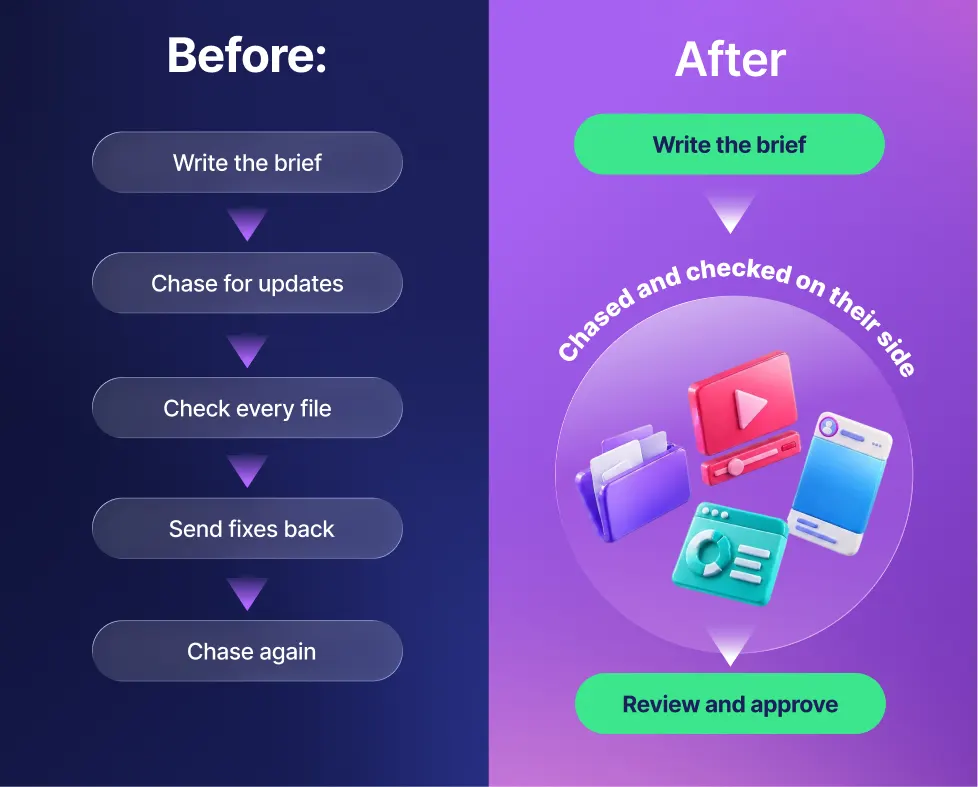
You get your time back. Every hour spent making, chasing and checking artwork is an hour not spent on strategy, planning, and the work that moves your numbers. With the design off your desk, much of that time comes back to you.
Less back and forth over time. When the same designers stay on your account, expect some back and forth on the first few jobs: your feedback is how they learn how your team applies the brand. After that, there's less explaining, fewer avoidable revisions and more work right the first time.
Your spend matches your season. Size the plan for your usual workload, and cover the busy months with extra hours or a bigger plan, so you're not paying for your busiest month all year. Ask when an upgrade or a downgrade takes effect.
How it compares to the alternatives
Each option suits a different kind of design work, and many teams use more than one.
| Option | Good for | Can break down when | A subscription fits when |
|---|---|---|---|
| Freelancers | A specific project or a specialist skill you need for a short stretch. | The workload grows past what they can commit to. Availability can get thin as other clients compete for the same hours, and managing several freelancers starts eating the time you were trying to save. | Design is a steady, ongoing load. |
| Agencies | Strategy and senior creative direction, a brand build, a big campaign concept. | You need lots of everyday design. A project-based arrangement can be awkward for the small stuff, and layers of approval can slow it down. | You'd rather cover the everyday work with a monthly plan than a quote per project. |
| Hiring | Enough steady work to justify a full salary, and someone embedded in the business day to day. | You need the hours now (recruiting, notice periods and settling in usually add up to months), your workload moves around too much for a permanent cost, or the full cost and the managing outweigh the hours you actually need. | Your steady work is less than a full designer's worth, or you need the hours before a hire can start. |
| DIY tools (Canva and similar) | Small businesses and simple, templated work. If you're early or your needs are basic, a DIY tool is cost-effective and worth using. | The work gets more involved, or your own hours become too valuable to spend on production. | There's enough design work that doing it yourself costs you more in time than it saves in budget. |
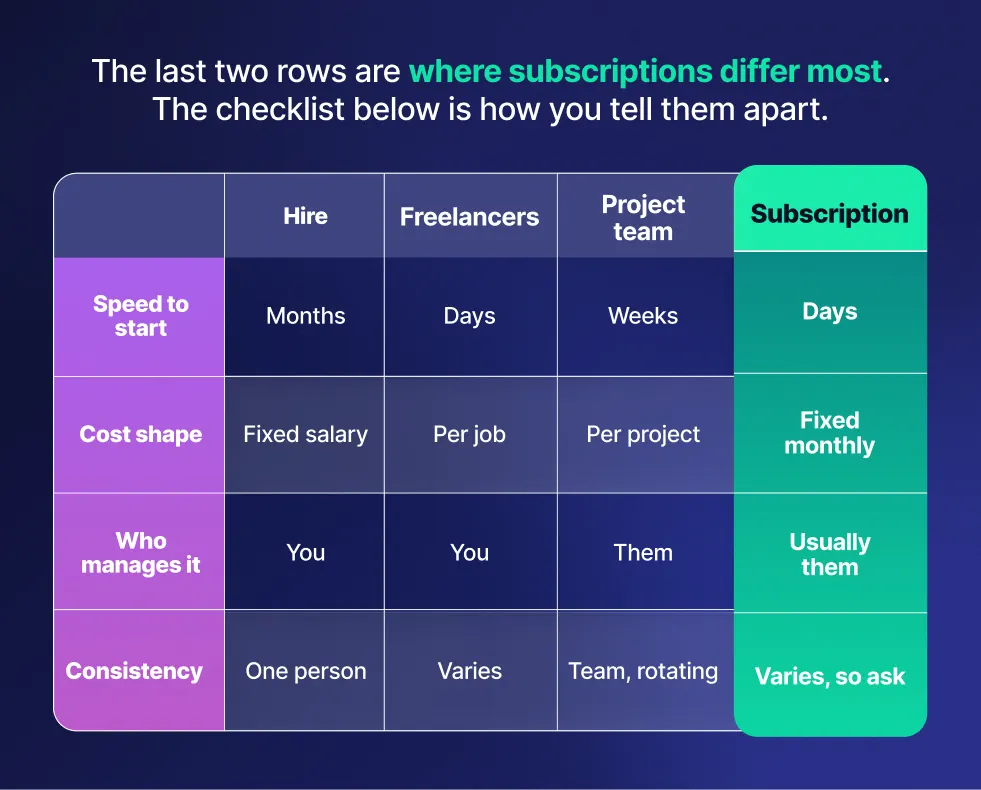
So, is a design subscription right for you?
It makes sense when:
- You need more design hours than your team has, and you can't hire fast enough or can't get headcount approved.
- Your team is working hard, and the backlog never shrinks.
- You have no designer in-house, and design keeps landing on your team on top of everything else.
- You run several brands or locations, and each one needs its own versions.
- You have steady work all year, with peaks you need to scale up for: campaigns, launches, appeal seasons, or EOFY.
- You've tried freelancers, but briefing, chasing, and checking their work eats more of your time than it saves.
It doesn't make sense when:
- Your design needs are occasional: a campaign here and there, with little work in between. At that level, a freelancer or a one-off project suits the need better than a monthly plan.
- You're an early-stage business that just needs something quick and cheap to get up and running. A DIY tool or a small scoped project may be all you need for now.
- You need brand strategy: the research and positioning that come before the design. A brand strategist is the better fit for that work up front, and a production-led subscription takes it from there.
The teams that get the most from a production-led subscription have a clear brand direction and steady work to get done.
How to choose a provider
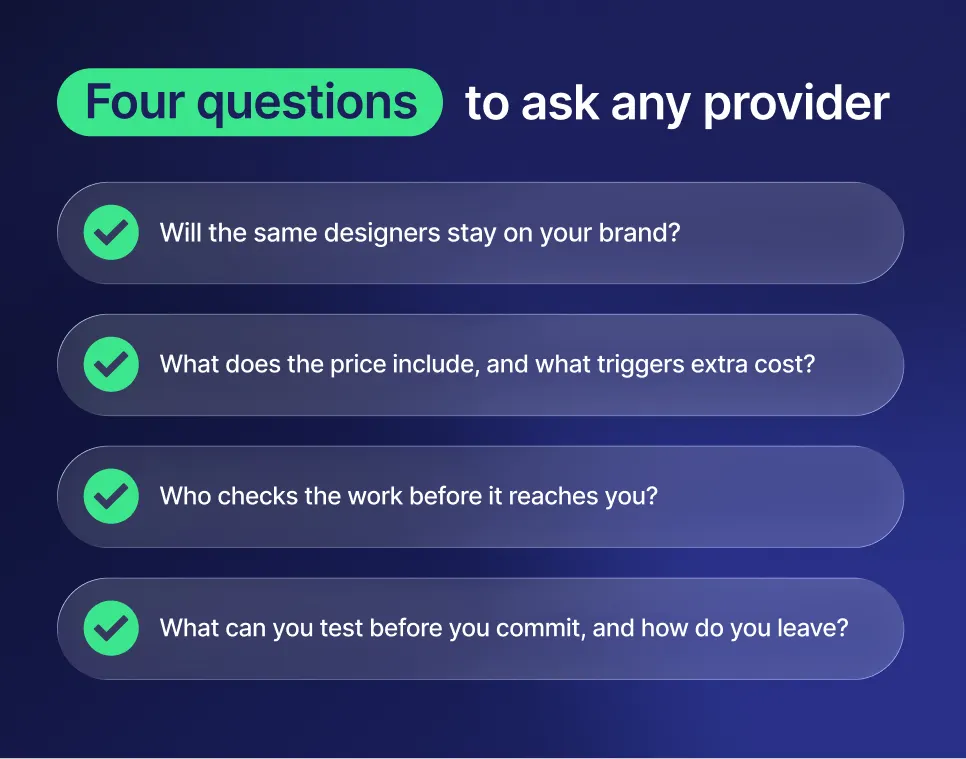
Start from what you need, then check each provider against it. Five things to settle:
1. Decide whether you're giving an instruction or direction
An instruction says exactly what to make, like resizing an approved poster, and it's the quickest and cheapest way to get simple work done. Direction gives the designer your brand guidelines, your audience and the job the design has to do, with room to improve the layout and execution. That takes more time, so it costs more. Some providers work only from instructions. Others take direction, make the design calls and push back when something won't work. I give our clients the same advice: if you want it simple and quick, give an instruction. If you want the design to come back better than the brief, give direction, and allow the time for it.
2. Check who does the work
Ask about the designers' experience, and look at work they've done for brands like yours. Ask how they read a brief, explain their choices and spot problems before work starts.
3. Work out how much design you need each month
Add up a typical month, or use our free Design Hours Calculator to work out your monthly hours.
4. Check what you can test before you commit
A trial period, a money-back guarantee: some way to see the real service before you're locked in. Portfolios can look impressive, but a trial shows you the real thing. If there's no way to try and no easy way to leave, all the risk sits with you. At Andelo, if your first month with us isn't right, tell us within the first 14 days and we'll refund that month's fee. This doesn't apply to prepaid 12-month terms.
5. Ask who checks the work, and when you can see progress
Find out who checks files before delivery and how often you'll get an update. On an hours-based plan, ask when you can see the hours used. If you're the only one checking files and you only see the hours at month-end, much of the managing is still yours.
Frequently asked questions
How much does a design subscription cost?
It depends on the model: hours-based plans are priced by the hours you buy each month, and unlimited plans by what they include, such as how many requests are worked at once. At Andelo, plans start at $1,895 AUD a month for 30 hours, plus GST. See every plan on the pricing page. Work out your own number first, then compare it against each provider's plans, asking for a written price where they don't publish one.
Are lower-priced design subscriptions worth considering?
They can be, if the scope and service suit your work. Compare how much work can move at once, the designers' experience, and who manages and checks it. Some lower-priced plans include project management and quality checks, so price alone won't tell you what's missing. Ask who checks the copy, dimensions and location details before the work reaches you.
Is "unlimited design" actually unlimited?
No. It means unlimited requests in a queue, worked on a set number at a time. How much work you get back is set by how fast the queue moves, which is why two "unlimited" plans at different prices deliver very different amounts of work. Ask how many requests are worked at once, how long work like yours usually takes, and whether revisions hold up the next job.
Do you get a dedicated designer, or a rotating one?
It depends on the provider. Some keep the same designers on your brand, and some pass each brief to the next designer who's free, which can mean explaining your brand more often. On smaller plans, your designers will also work for other clients. Ask who will work on your brand, and how they keep what they learn about it. At Andelo, the same senior designers work on your account.
Is there a lock-in contract?
Often not: many design subscriptions run month to month and can be paused or cancelled, though some require longer terms. Check the notice period, any minimum term, and what happens to work in progress. Where longer terms come with a better rate, weigh the saving against the flexibility you give up. At Andelo, monthly plans have no lock-in. 6-month terms are 5% off, 12-month terms are 10% off and paid upfront, and each runs for the term you choose.
How fast does a design subscription deliver?
It depends on the provider, the job and the queue, so ask what the quoted time means: a first draft, or the final file. Complex work like campaign concepts or long documents takes longer, and a complete brief moves faster than a vague one. At Andelo, most work lands in 2-3 business days. Each brief gets a committed date for the first draft, and we hit the date we give. Revisions get their own dates. Small jobs sent before 12pm Sydney time can land the same day.
Can AI design tools replace a design subscription?
AI tools can do part of the work, like making quick variants or resizing something that already exists. They don't replace the judgement around it: deciding what's right for your brand, noticing what's subtly off, and owning a date. Someone still has to brief the tool, review what comes back, and fix what doesn't land, and that someone is usually you. Our designers use AI in production, so your hours go further. A senior designer still makes every call and checks every file.
Should you hire a designer or use a design subscription?
It depends on how much steady work you have. In our calculator, we allow about 120 hours a month of design work from a full-time designer, after leave, meetings and admin. Steady work near that level, mostly of one kind, can justify a hire. Below that, consider what else the role would own before committing to a full-time salary. If you do hire, a subscription can cover the work while you recruit, then stay on for the peaks and the mix of work one person can't cover. Many teams run both: in-house for direction, subscription for volume. At Andelo, your account can be up and running in 1-2 business days.
This guide draws on our own production experience and providers' published information. The calculator's hours are typical for standard work, and every real brief gets its own estimate.
Stephen Andelo is the founder of Andelo. Andelo is a design subscription for Australian teams with steady design work. He writes about what actually works when there's more design work than your team can take on.