When to outsource design vs hire in-house

The production load has crept past what your team can hold, and you're at the point of adding design hours. How you got here varies, but the question lands the same way on every desk: do we hire, or do we outsource?
The trouble is how the question arrives: as a binary, hire or outsource, pick one. Answered that way, it can be an expensive mistake in either direction. This guide sorts which work belongs where, then gives you the per-hour maths and the answers finance will ask for, so the call survives the budget conversation.
4 questions that tell you more than the rest of this article
- Do you have a consistent monthly volume? Consistent → lean toward hiring. Variable → lean toward outsourcing.
- Do you have someone with the bandwidth to manage a new hire? Yes → hiring is viable. No → outsource until you do.
- Is the work setting the brand's direction, or delivering inside it? Setting direction → keep that in-house, whether that's you or a hire. Delivering inside it, creative calls included → outsource.
- When do you need the extra hours? Within weeks → outsourcing is the only option that moves that fast. Next quarter or later → both are open, and recruiting takes months from job ad to useful work.
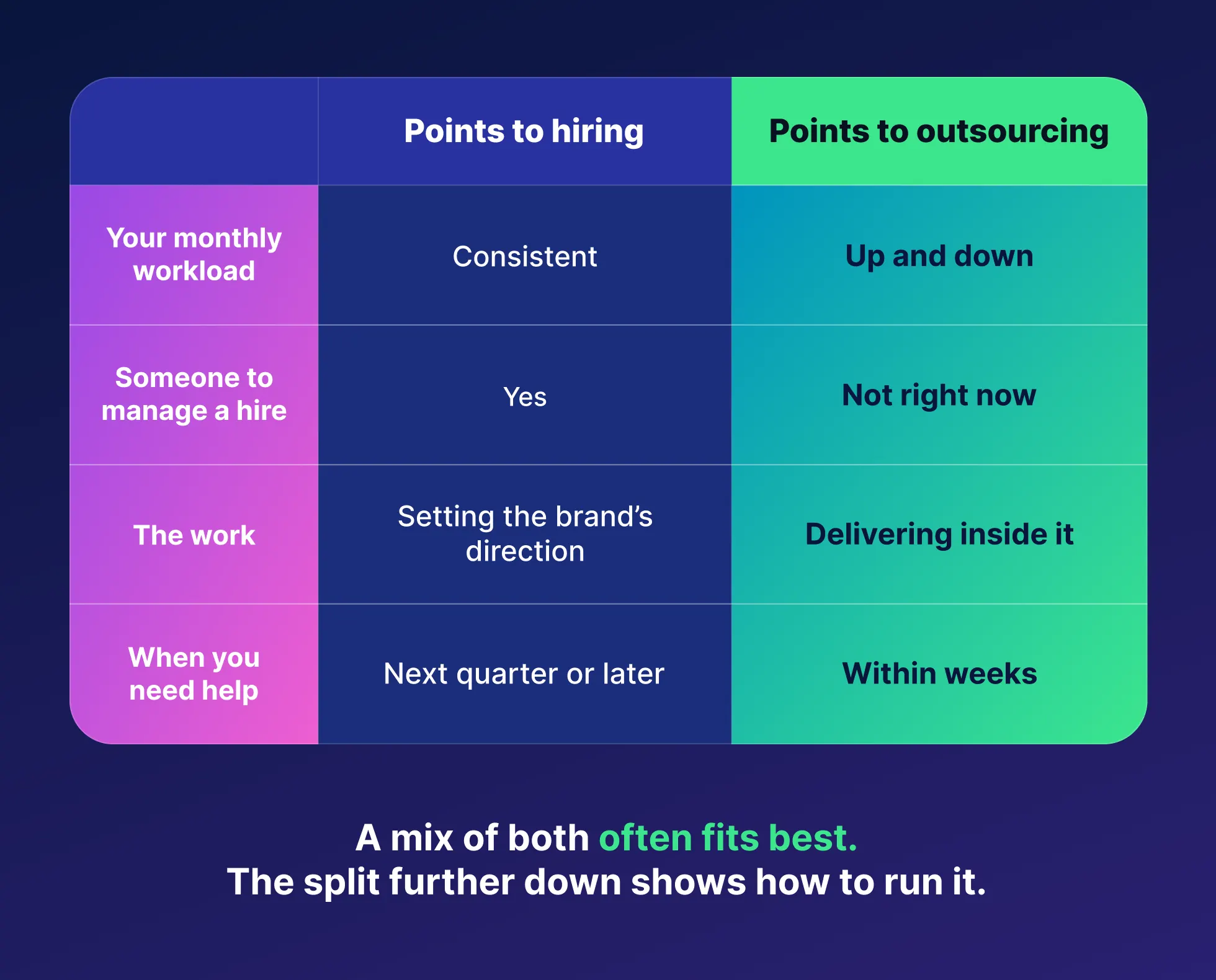
Mostly "outsource": a design team will solve your problem faster than a hire. Mostly "hire": keep reading, because there are hidden costs that are easy to leave out of the budget. A mix of both: that often fits best, and it's pointing you at the hybrid split below.
When outsourcing is the wrong call
Three situations where outsourcing is the wrong answer, however good the design team is. They're the flip side of questions one and three:
- Your volume is steady at a full-time load and it's mostly one kind of work. At that point you're paying external rates for hours a salary covers more cheaply, and the per-hour table below shows exactly where the lines cross.
- Your volume is too small to justify a standing arrangement. Under about 30 hours a month, occasional, well-defined help will serve you better than any standing arrangement.
- The work sets your brand's direction, or depends on context that only lives inside your organisation. Direction needs an owner on your side of the table. A design team can shape it with you and deliver everything underneath it, but nobody outside your team can hold it for you.
When hiring is the wrong call
Five situations where a hire is the wrong answer, however good the designer is. They're the flip side of questions one, two and four:
- Your volume moves around. A salary pays for fixed hours. Quiet months are paid for whether the work fills them or not, and in the peak months one person still can't absorb the spike.
- The work is mostly production. A full-time designer ends up on resizes, EDM updates and presentation formatting on a full designer's salary. The backlog doesn't shrink, it moves sideways.
- Your brief list spans several crafts. Presentations, social, print, illustration and motion are different specialisms, so one hire covers part of your list well and the rest adequately. Covering all of it means hiring more than one person.
- You need more hours within weeks. Between recruiting and onboarding, it's months before the backlog feels any different. That's a long time to pay for hours you don't have yet.
- Nobody has the bandwidth to manage a hire. Briefing, feedback, workload balancing and development are somebody's job. Without that time, the person who hired them ends up doing the thinking the hire was meant to remove.
None of that is a knock on any designer. The problem is casting: one person's range asked to carry the whole load.
If all four questions above point to hiring, hire. If you're forcing even one answer because you want it to be true, outsource.
What each option really costs
Hiring
A designer costs more than their salary. Super, leave, equipment, software licences, training and office costs come on top. The side-by-side maths is below.
Recruitment is slow, and it costs your team too. While you're interviewing, your existing team is absorbing the extra workload. By the time the new hire starts, someone else is close to burning out.
The biggest hidden cost: what happens when they leave. And designers don't stay forever. When one leaves, you start over. Months of recruiting, weeks of onboarding, and every in-flight project handed to someone without the context. That's a lot of starting over.
Outsourcing
The ramp costs you time before it saves you any. Fuller briefs, explaining things you've never had to explain, writing down preferences that used to live in someone's head. That work lands on you, in the weeks you're already short.
You'll never have them in the room. An external team isn't in the meeting where the priority changed, or the corridor conversation about the stakeholder who hates green. You relay it every time, and some of it doesn't survive the relay. Onboarding narrows that gap. It doesn't close it.
You're one account among several. Your work is scheduled against other clients' work, and you don't see the trade-offs being made. In a stretched month you'll notice it as turnaround quietly creeping out, usually without being told.
When it ends, the brand knowledge leaves with them. The same exposure as a departing hire, except it was never inside your organisation to begin with. If the relationship breaks down mid-campaign, you're starting over with someone new and a deadline already running.
The numbers, side by side
The full-year maths for the hire, as a planning assumption you can swap for your own numbers: $95,000 a year all in, covering salary, the 12% superannuation guarantee (ATO, the current legislated rate), workers compensation, software and equipment. That allows for a salary of about $80,000, inside the range SEEK shows for graphic designer jobs in New South Wales: $75,000 to $90,000 a year (SEEK salary insights, October 2026).
Now finish the comparison properly: divide by the hours you'll actually use. A hire's cost is fixed. What it costs you per hour depends entirely on how many of those hours your work really fills.
Working assumptions, stated so finance can check them: $95,000 a year all in, and about 1,440 design hours a year: the calculator's 120 a month, rounded up from about 112 once annual leave, public holidays, meetings and admin come out.
| Your real monthly demand | Hire: cost per used hour |
|---|---|
| 40 hours | about $198 |
| 60 hours | about $132 |
| Full load (about 120 hours) | about $66 |
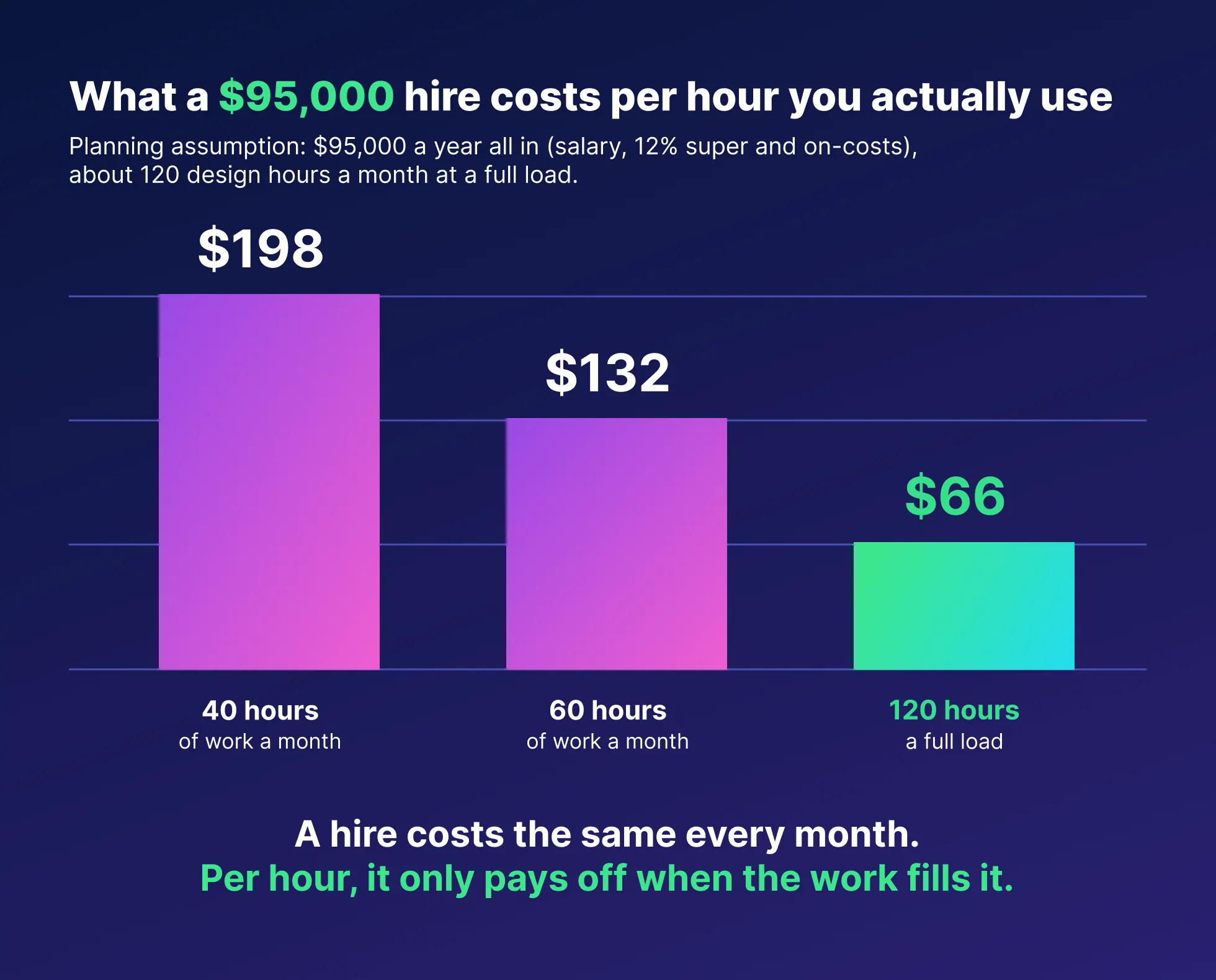
Against that: ad-hoc agency work is billed by the hour at any volume. Read the table honestly in both directions. At genuine full load, the hire is competitive per hour, and that's exactly when hiring is right. Below it, you're paying salary for hours your work can't fill, and the per-hour cost climbs fast.
What your volume says
Put your monthly number against these bands and the shape mostly picks itself:
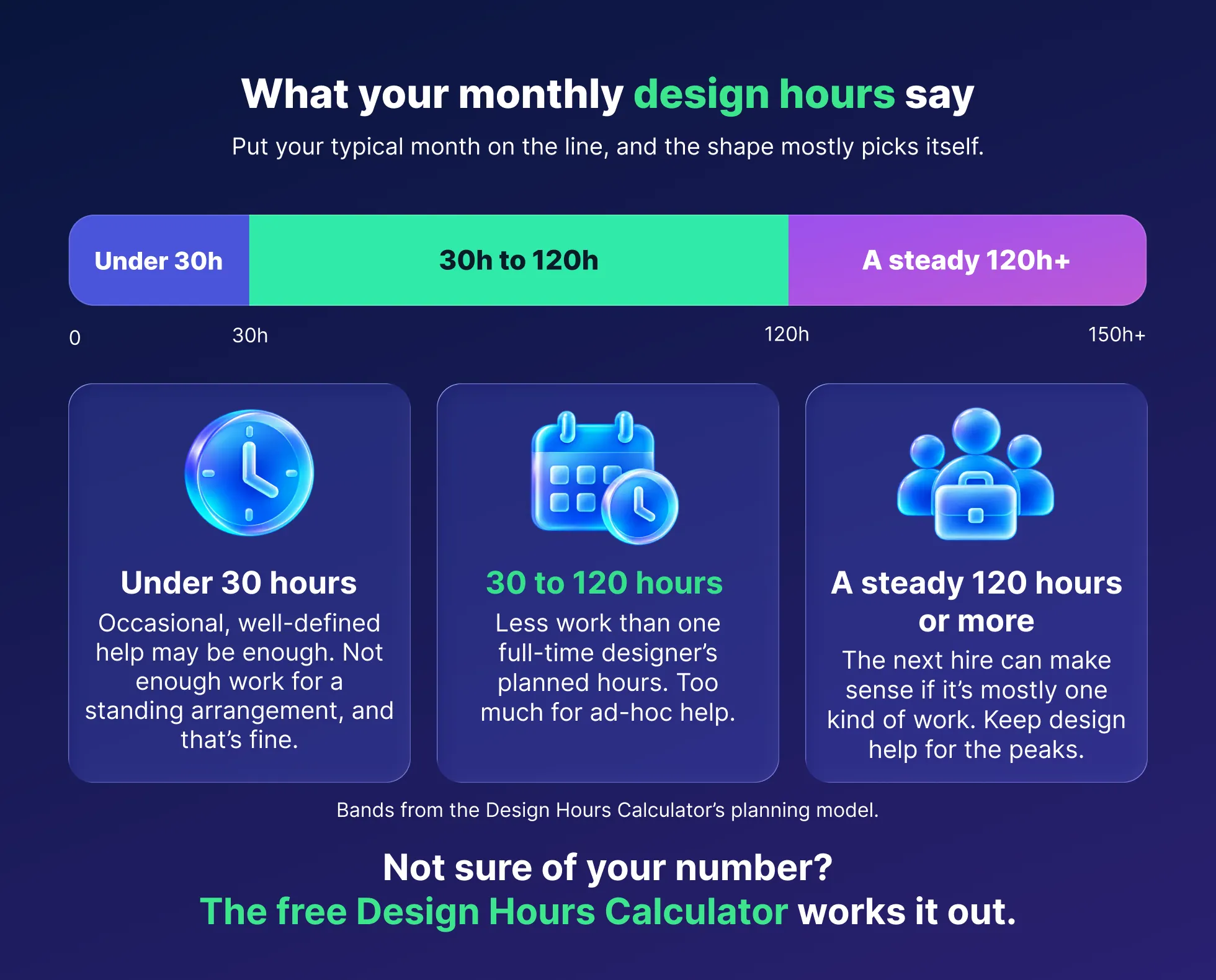
Not sure of your number? The free Design Hours Calculator works it out.
- Under 30 hours a month: occasional, well-defined help may be enough. There isn't enough work to justify a standing arrangement, and that's fine.
- 30 to 120 hours: less work than one full-time designer's planned hours, and too much for ad-hoc help. A hire at 40 hours of real work a month runs about $198 per used hour, and about $132 at 60. At this volume the work usually spreads across formats too, which is where a single hire's craft ceiling starts to bite.
- A steady 120 hours or more, mostly one kind of work: that's the full-time load from earlier. The next hire can make sense here. Keep design help for the peaks and the specialist formats.
What finance will ask
Five questions that come up in almost every budget conversation about this. Walk in with the answers:
"Will the hours actually be used?" A hire is fixed hours, paid for whether the month fills them or not. Outside help on a monthly arrangement can be sized to your demand, and ad-hoc is pay-per-job. This is the utilisation question, and the table above is the answer to bring.
"What does it cost to exit?" A hire means notice, possibly redundancy, and the cost of recruiting again when volume returns. A month-to-month arrangement costs one month to unwind. Anything with a lock-in costs the remainder of the term: check before you sign.
"Who covers leave and sick days?" One designer is six-plus weeks a year of planned absence (annual leave and public holidays under the NES), plus the unplanned kind, with no cover. A design team carries its own coverage. A single freelancer is the same exposure as a hire.
"Who manages the work?" A hire needs a manager: briefing, reviews, one-on-ones, and that time comes out of a manager's week. With outside design help, ask directly whether coordination and quality checking are included or whether you're still the project manager. The answer varies more than the price does.
"What happens if they leave?" Designers change jobs, and the ramp cost you paid walks out with them. A design team holds brand knowledge across more than one head, so continuity is less exposed to any single departure.
What the split looks like
Most of the answers above point at a mix rather than one or the other. Running both deliberately is what that looks like, and the shape depends on what you already have in-house.
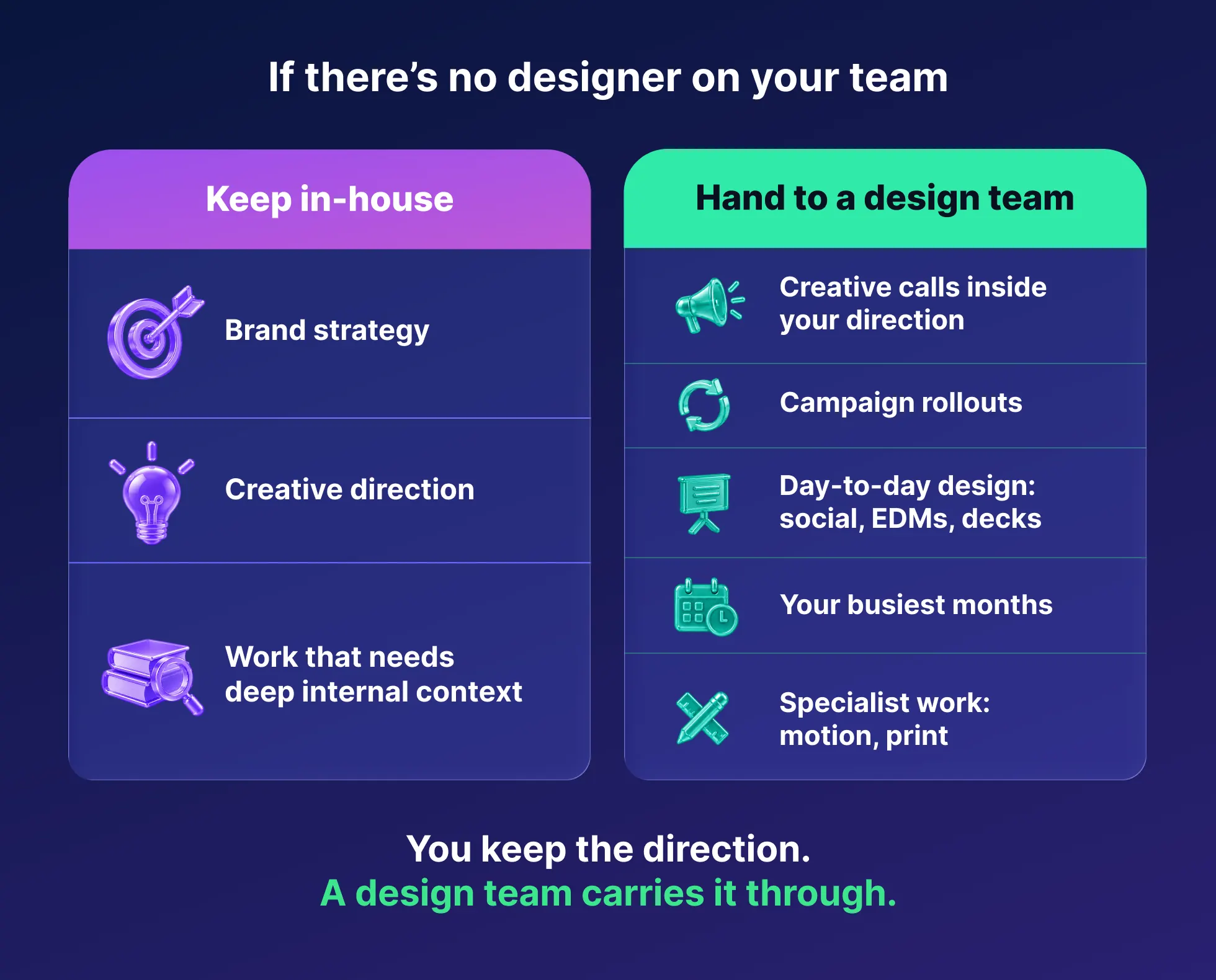
No designer on the team: you keep the direction, and a design team carries it through. It splits like this:
A designer on the team: they own the day-to-day, the routine work and the work that needs deep internal context. A design team becomes the layer around it: the campaign creative, the peaks one person can't flex to, the pieces that need specialist craft. Your designer directs more work than one person could produce alone.
| In-house | Design team | |
|---|---|---|
| Brand strategy | Yes | No |
| Creative direction | Yes | No |
| Work that needs deep internal context | Yes | No |
| Creative calls inside your direction (layout, hierarchy, execution) | No | Yes |
| Campaign rollouts | No | Yes |
| Production volume (social, EDMs, presentations) | No | Yes |
| Peak coverage | No | Yes |
| Specialist crafts (motion, print) | No | Yes |
Nobody leading your marketing is resizing banners. Nobody external is guessing at the strategy. Everyone is doing what they're best at.
What getting this wrong costs you
If you hire when you should have outsourced: You've spent a year's salary and months of recruiting. Your designer is doing production work they're overqualified for. Your backlog is the same size, because production volume tends to expand to fill the hours available. And when campaign season hits, you're still short. Because one person can't flex.
If you outsource when you should have hired: You've got fast production but nobody steering the brand. Everything looks like it was designed by a different person each week. Your team is spending more time writing briefs and managing vendors than they'd spend managing one good internal designer.
If you do nothing: The backlog grows. Your best people start doing production work because there's no one else. The person leading your marketing is resizing banners at 6pm on a Thursday, while the appeal launch, or the new clinic's collateral, or the campaign that matters most sits untouched. And the strategic work keeps getting pushed to "next quarter."
The real decision is which kind of work needs which kind of help. Answer that, and the rest falls into place.
Still weighing it? The free Design Hours Calculator does the hours maths for you: how many hours your brief volume needs, before you commit to either path.
Stephen Andelo founded Andelo and has been designing since 2009. Andelo is a design subscription for Australian teams with ongoing design work across brands, sites or campaigns. Plans start at $1,895 AUD a month for 30 hours, GST included.
Now you know what it takes. If you'd rather spend your time on the direction and have a design team carry it through, that's what we do. Book a call at andelo.com.au/book-a-call.